One of the most common objections about the Bible is that it was supposedly created by Roman Emperor Constantine at the Council of Nicea in AD 325. Of course, that’s not true. It’s mythology, not history. So what really happened at the council of Nicea?
Where?
Nicea (Nicaea) was an ancient Greek city, now part of Iznik, Turkey. This was about 75 miles from Constantine’s capital in Nicomedia, and a convenient location for travelers.
When?
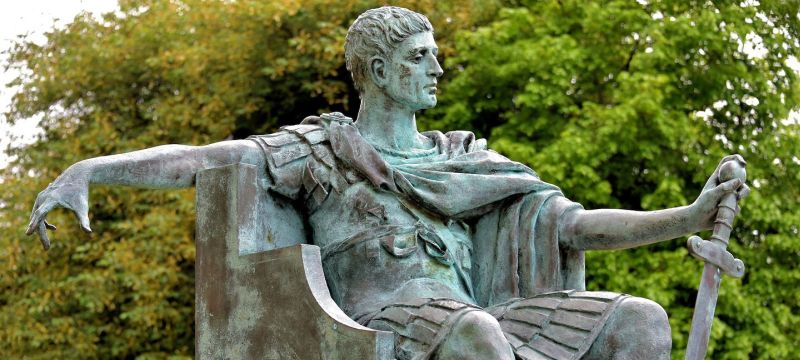
Constantine (Caesar Flavius Constantine I) became the western Roman emperor in AD 306, and became the sole ruler of the Roman empire in 324 after defeating eastern Roman emperor Licinius at the battle of Chrysopolis. The council at Nicea was convened the next year, from May/June through July, AD 325. Expenses were paid for by the Empire.
Who?
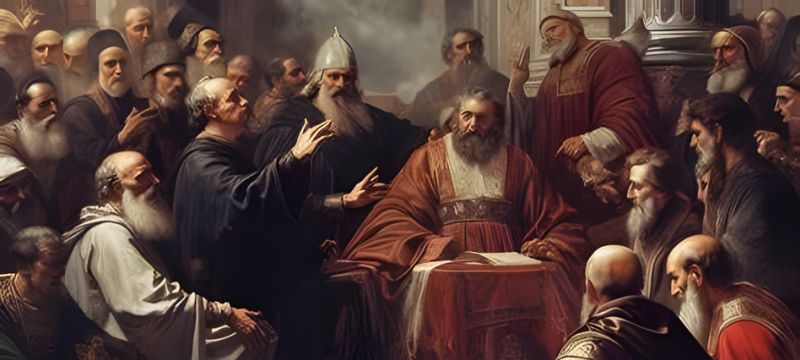
This is considered to be the first ecumenical council. That is, the first attempt to gather representatives from all of the Christian churches to settle disputes. Around 1800 bishops were invited – all of the bishops at that time – while only between 250 and 300 or so attended. Some wrote that 318 were in attendance, but that number may only symbolize the 318 trained men of Abraham’s household as found in Genesis 14. Because bishops often had multiple presbyters and deacons with them, the total attendance may have been around 1800. Constantine took part in discussions, but didn’t vote because he wasn’t a bishop. Pope Sylvester I was represented by emissaries. Claims that the council was attended by groups like Gnostics or Ebionites are unfounded.
Why?
It appears that Constantine considered religious disputes to be a problem for a united Roman empire, so the council of Nicea was convened to settle theological issues. This wasn’t the first time Constantine worked to settle religious disputes. Twelve years earlier, in AD 313, he and eastern emperor Licinius co-authored the Edict of Milan, granting official toleration to Christians in the Roman Empire. He later tried to resolve a dispute over Donatism, appointing Miltiades of Rome to hear the dispute and then calling the Council of Arles in 314. The need for the Nicene council began with a number of issues, especially a dispute over Arius’ view of the nature of Jesus as Son of God.
Constantine’s Invitation
The original proclamation of the council only survives in a Syriac translation. Here’s an English version:
I believe it is obvious to everyone that there is nothing more honorable in my sight than the fear of God.
Though it was formerly agreed that a council of bishops should meet at Ancyra in Galatia, it seemed to us for many reasons that it would be better for the council to assemble at Nicaea, a city of Bithynia, because the bishops from Italy and the rest of the countries of Europe are coming, because of the excellent temperature of the air, and in order that I may be present as a spectator and participant in what will be done. Therefore I affirm for you, my beloved brothers, that you should all promptly assemble at the said city, that is at Nicaea.
Let every one of you therefore, as I said before, keep the greater good in mind and hurry to gather without any delay, so that each may be physically present as a spectator of those things which will be done.
May our God keep you, beloved brothers.
Issues Discussed at the Council
Arianism
The exact nature of Jesus, the Son of God, had been an issue for some time. Nearly a century earlier, Sabellius taught that Father, Son and Holy Spirit were three separate modes in which God appeared throughout history. He was excommunicated in AD 220, and almost none of his writings survive. His modern followers include the Unitarians and Jehovah’s Witnesses.
Arius, a priest in Alexandria (Egypt), argued with his bishop Alexander over whether the Son was a subordinate creation of the Father, or is eternally God… and whether the Father and Son were ‘of different substances’ (heteroousios) or ‘of one substance (homoousious). For this view, Arius was declared a heretic by 80 church leaders in 320, and again by more than 100 leaders in 321. While in exile, his position continued to gain a hearing, and Constantine wished to have the matter settled.
In the meantime, Eusebius of Nicomedia (not to be confused with Eusebius of Caesarea) had reinstated Arius. Alexander wrote a statement of faith that 250 leaders signed, then convened a council that agreed that Arius was still excommunicated. Arius complained directly to Constantine, which led to him convening the Council of Nicea.
The Nicene council consulted Scripture and discussed the issue at length. Beyond the obvious – that Arius’ views contradicted Scripture – a primary argument against his view was that his ideas were new, and were not taught in early church history. In other words, Christians had always understood Scripture to say that the Son is God (John 1), that He had always been God (John 1), and that He is equal to the Father (Philippians 2)… and that Arius contradicted both Scripture and the witness of centuries of faithful believers. Athanasius asked, “How many fathers [early Christian writers] can you cite for your phrases?” To settle the matter, the Nicene Creed was written – line by line – to ensure that Christians could properly express the three-fold nature of God.
All but Arius and two other bishops signed the creed: Theonas of Marmarica and Secundus of Ptolemais. Arius’ teachings were declared heretical, and his books were to be burned… and, by Constantine’s order, anyone hiding copies of Arius’ writing would be put to death.
All three were anathematized and exiled to Illyria, but this didn’t settle the matter. Arianism continued to plague the church for more than a century. It’s reported that Constantine’s sister urged him to support Arias, and it seems that his position softened over the years to a more inclusive view. The Synod of Jerusalem restored Arius in AD 336, and Constantine invited Arius to come back… but Arius died – weirdly, his intestines exited his body while in the bathroom – before he arrived.
One of his followers, Eusebius of Nicomedia, became an advisor to Constantine, baptizing him just prior to his death in AD 337. This served to promote Arianism, and the following two emperors (Constantius II and Valens) were Arians. Athanasius continued to fight against Arianism, arguing from Scripture. Emperors removed him from his position as bishop 5 times, resulting in 4 different emperors reinstating him.
Modern groups like The United Pentecostal Church and Oneness Pentecostals continue to promote the Sabellian heresy, while Jehovah’s Witnesses and, to some extent, Mormons continue to promote the Arian heresy.
What else did they discuss?
Twenty disciplinary decrees were issued, and a letter was written to Alexandria to announce the council’s decisions. Here are some of the topics of the day:
- They formally denounced Gnosticism and other minor sects.
- Soldiers who had renounced their position and returned to it were given penance.
- Those who professed faith (catechumens) but lapsed prior to baptism were allowed to rejoin as catechumens after a period of three years.
- Only specific people were allowed to offer the Eucharist, and others who did were to be suspended from their ministry.
- Followers of deposed, anti-trinitarian teacher Paul of Samosota who wanted to rejoin the church could be rebaptized after affirming the Trinity.
- The Nicene Creed was written to codify the consensus about Arius’ view.
Clergy Stuff
- Clerics lending money with interest were to be condemned.
- Healthy clergy who castrated themselves were disqualified from ministry.
- New bishops were to be chosen by all of the other bishops in their region, but three would do in a pinch… as long as the others wrote letters of approval.
- Bishops, priests, and deacons were not allowed move from one church to another.
- In light of the fact that recent converts had sometimes been made clergy, they were to be given time and grace to mature… but, “with the passage of time,” if they were found guilty of “sins of sensuality” they would forfeit their position.
- No member of the clergy could have a woman living with him, other than a mother, sister or a person similarly “above suspicion.”
- Discussions about excommunicated clergy should be held at twice-yearly meetings, to make sure they hadn’t been kicked out due to the pettiness of their bishop.
- As was the custom, regional church authorities were to be recognized. For example, Egypt, Libya and Pentapolis were under the authority of the bishop of Alexandria. Anyone made bishop without proper regional authority was not to be considered a bishop.
- They resolved the Miletian schism, dealing with clergy who had lapsed under persecution.
Tried and Failed
- Failed to establish a uniform date for Easter, which is still unresolved.
- Socrates Scholasticus wrote that they had intended to make a law enforcing celibacy of the clergy, but failed due to objections.
There is no record of any discussion of the biblical canon at the council.
Objections
Didn’t the Council of Nicea decide on the use of the word “trinity”?
The word trinity originated in the 1200s. While the word didn’t yet exist, the doctrine did. Tertullian and Origen wrote about the three-fold nature of God 150 years before the Council of Nicea. The idea is found in other early writings, like the writings of Polycarp, Ignatius, and Justin Martyr.
What’s the big deal about Arianism? Does it really matter?
Yes, it matters. If Jesus is not God, He should not be worshiped. If Jesus is God, He should. As we see that Jesus was worshiped in Scripture and has been worshiped throughout history as God, this is considered an essential tenet of the faith.