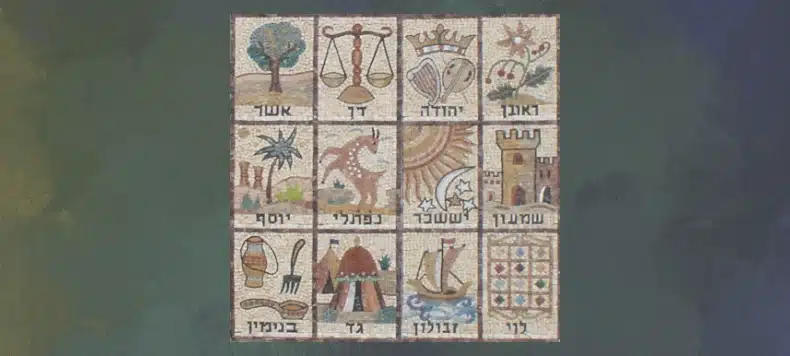
Tag: The 12 Tribes of Israel

  • Who Were the Lost Tribes of Israel?

    Who Were the Lost Tribes of Israel?

    Roland wanted to know about the so-called lost tribes of Israel. Here are some of the details.

    In the words of Rich Mullins, Jacob got two women and a whole house full of kids. Jacob, renamed Israel, had twelve sons by four different women: two wives and two concubines. Those twelve sons had their own families… twelve different tribes of Israel.

    MothersSons
    LeahReubenSimeon
    LeviJudah
    IssacharZebulun
    RachelJoseph
    Benjamin
    BilhahDan
    Naphtali
    ZilpahGad
    Asher

    So, how did any of them get lost? Well… for that, we fast forward a few generations. These twelve families had grown to become a very large number of people. After leaving slavery in Egypt, they settled in Canaan. At first, the ancient Israelites had no king. They had God as their king… or, to be more precise, they were supposed to. They had human spiritual leaders, like Samuel. When Samuel’s sons turned out badly, the elders of Israel didn’t want them in charge. They wanted a human king, so they could be like the other nations around them.

    That’s how Saul became Israel’s first king. Fast forward through King David and King Solomon to Rehoboam. After 3 years as king, the united kingdom of Israel split. The tribes of Judah and Benjamin were living in the south, which became the kingdom of Judah, where Jerusalem is. The other ten tribes lived in the north, including Samaria and Galilee, which became the kingdom of Israel. This was around 928 BC. For a list of rulers, see The Kings of Ancient Israel and Judah.

    Fast forward again, around 200 years. The Assyrian kingdom attacked the northern kingdom of Israel off and on for a decade or more and killed a lot of people. Along the way, they deported a lot of people to other places, spreading them out. This is a strategy for conquest. If you conquer a city and leave everybody there, it’s likely they will eventually revolt. If you capture the smartest and bravest and relocate them, the victims would eventually settle in their new homes, get married to locals, have kids, put down roots, and be assimilated into the culture. In that way, they would never again be a threat.

    The Assyrian kings involved were Pul (or Pulu, also known as Tiglath-pileser III), Shalmaneser V, and Sargon II. Over time, they conquered the entire northern kingdom of Israel. Those who were deported weren’t “lost,” of course. They would, however, lose their identity over time. Also, there were many who fled south into Judah. Asa, king of Judah, listened to Azariah the prophet and removed the idols and altars to other gods. He also repaired the altar to Yahweh that was in front of the temple. This began a revival of sorts in Judah:

    Then he assembled all Judah and Benjamin and the people from Ephraim, Manasseh and Simeon who had settled among them, for large numbers had come over to him from Israel when they saw that the Lord his God was with him. They assembled at Jerusalem in the third month of the fifteenth year of Asa’s reign. At that time they sacrificed to the Lord seven hundred head of cattle and seven thousand sheep and goats from the plunder they had brought back. They entered into a covenant to seek the Lord, the God of their ancestors, with all their heart and soul.

    Significance

    Part of Roland’s question was about the significance of the lost tribes. I see two parts to this:

    • a lesson to learn, and
    • urban legends.

    The lesson part can only be understood by reading the texts as found in the Bible. You see, most of these problems began with King Solomon. He did not obey God, allowing his many wives to influence him to worship other gods. As a result, God told Solomon that He would tear the kingdom away from his son and give it to a subordinate. That was Jeroboam, who rebelled against Solomon’s son Rehoboam and caused the united kingdom to split into north and south.

    Not only was it God who actually caused the kingdom to split, it was God who also stirred up the spirit of the Assyrian kings to invade the north. So the dispersion of the ten Israelite tribes from the northern kingdom was punishment for idolatry. When Asa removed the idols from the southern kingdom, the people responded to God’s discipline by entering into a new covenant with God, promising to obey Him.

    As for the urban legend part, I don’t put much stock in urban legends. There are many of them. Some relate to where the Israelites ended up, from China and Japan to Nigeria and the Americas. Some may be based in history, some are clearly myth. Others relate to what will happen in the ‘last days,’ where the lost tribes will (or won’t, depending) reunite with Judah and Benjamin. As fun as it is to speculate, it’s unwise to create theology from speculation… so urban legends are fascinating, but not the building blocks for any real conclusions.
  • Israel

    Israel

    The word Israel appears in the Bible over 2,400 times, and it’s used in a number of different ways. The word itself is difficult to precisely define. The el part of the word refers to God, as in Elohim. The rest of the word comes from the Hebrew sara, usually defined as to wrestle, or compete.

    Jacob

    In Genesis 32 we read about Jacob, and how he wrestled with a man throughout the night. In verse 28 the man said, “Your name will no longer be Jacob, but Israel, because you have struggled with God and with humans and have overcome.”

    Children

    Jacob, now Israel, had 12 sons. Each son had a family, and – as was common then – Jacob’s descendants were known as the ‘children of Israel.’

    Nation

    Later, Jacob’s descendants grew in number and chose a king, and became known as the ‘nation of Israel.’ After Saul, the first king, came Ish-Bosheth, David, and Solomon. After Solomon’s death, the kingdom of Israel split into two kingdoms for around 350 years, from 928 BC to 587 BC: Israel in the north and Judah in the south. Today, of course, Israel is again a sovereign nation.

  • Ox, Man, Lion, Eagle, the Compass, the Tribes and the Gospels

    Ox, Man, Lion, Eagle, the Compass, the Tribes and the Gospels

    An interesting question found my inbox this week. A GodWords friend was wondering about the connections between these things found in Scripture:

    • The cardinal points on a compass (North, South, East, West)
    • The ancient Israelite tribes of Judah, Ephraim, Dan, and Reuben
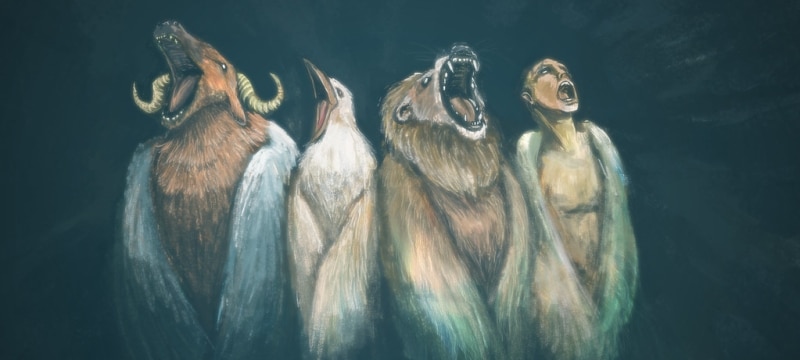
    • A lion, an eagle, an ox, and a man
    • The gospels of Matthew, Mark, Luke, and John

    It appears that most of this is traditional, rather than scriptural. That’s not to say they’re not well-established, though. For example: a quick look at the history of Christian art shows that the writers of the gospels are often associated with those four animals. Small things found in the Bible, or interpreted from the Bible, seem to have led to these symbols being used.

    I wouldn’t suggest that there’s any deep, hidden spiritual meaning in these connections. If there were, it would be spelled out in the Bible for all to see… after all, God doesn’t keep secrets. However, explaining how these came to be is actually pretty complex. Each of these sets is known as a tetramorph. Tetra is “four” and morph is “shape.”

    The Compass

    We see the cardinal signs (north, south, east, west) in Numbers 2. While traveling in the wilderness between Egypt and the promised land, the Israelites were to arrange themselves into groups and camp in a way that surrounded the tent of meeting (tabernacle).

    Verse 3, the east side: Judah, Issachar, and Zebulun, sons of Leah.
    Verse 10, the south side: Reuben, Simeon, and Gad, sons of Leah plus Gad, son of Leah’s maid.
    Verse 18, the west side: Ephraim, Manasseh, and Benjamin, sons and grandsons of Rachel.
    Verse 25, the north side: Dan, Asher, and Naphtali, sons of the maids of Leah and Rachel.

    Verse 17 shows that the Levites were to be in the middle of the camps, next to the tent of meeting. So we can see why the tribes of Judah, Reuben, Ephraim, and Dan were associated with East, South, West, and North. It’s right there in the Bible. What about the animal symbols?

    The Animals

    Judah and the Lion:
    In Genesis 49, Jacob gathers his sons and tells them what to expect in the future. In v9 we see You are a lion’s cub, Judah; you return from the prey, my son. Like a lion he crouches and lies down, like a lioness—who dares to rouse him? Verse 10 connects the coming Messiah to the line of Judah. Jesus, the Messiah, is called the Lion of Judah in Revelation 5:5… so there is a strong connection between Judah and the lion.

    Reuben and the Man:
    Genesis 29:32 tells of the birth of Jacob’s firstborn, named Reuben… which means “see, a son.”

    Ephraim and the Ox:
    The son of Joseph, Ephraim was Jacob’s grandson. In Deuteronomy 33:17 we see Moses pronouncing a blessing on the tribes. Here’s what he said about Joseph, and – by extension – about Ephraim: In majesty he is like a firstborn bull; his horns are the horns of a wild ox.

    Dan and the Eagle:
    It’s interesting to note that Deuteronomy 33:22 associates Dan with the lion, not the eagle: Dan is a lion’s cub, springing out of Bashan. This suggests that Ephraim’s connection to the bull – at least in this specific passage – isn’t a spiritual designation from God Himself. If it were, we would expect Dan to be connected with the eagle.

    Weird Angels

    The Bible also refers to strange, angelic creatures that are associated with these four animals:

    Ezekiel 1:
    In Ezekiel’s first vision, he saw four strange creatures. In v10 we see this: Their faces looked like this: each of the four had the face of a human being, and on the right side each had the face of a lion, and on the left the face of an ox; each also had the face of an eagle. Strange indeed! Each creature had four faces, one with each of the symbols. The four sides of their heads could, in theory, symbolize the four directions in the Israelite camp. They’re identified in Ezekiel 10:15 as cherubim. 

    Revelation 4:
    In vv6-8 John records seeing four creatures in the heavenly throne room: In the center, around the throne, were four living creatures, and they were covered with eyes, in front and in back. The first living creature was like a lion, the second was like an ox, the third had a face like a man, the fourth was like a flying eagle. Each of the four living creatures had six wings and was covered with eyes all around, even under its wings.

    The Gospels

    Finally, we get to the four Gospels. How were Matthew, Mark, Luke, and John connected to these animal symbols? A number of early Christian writers interpreted the Scriptures in a way that combined them. These writers include Irenaeus and Jerome, among others. 

    Matthew and the Man:
    The gospel of Matthew emphasizes the humanity of Jesus, including a description of His birth and human ancestry.

    Mark and the Lion:
    This is a little more obscure. First, Mark’s gospel emphasizes Jesus’ kingship, and the lion often symbolizes the strength and ferocity of kings. John the Baptist, featured at the beginning of Mark, is said to bring to mind a lion’s roar with ‘a voice crying out in the wilderness.’

    Luke and the Ox:
    Luke emphasizes Jesus’ sacrifice, and the ox regularly symbolizes Israel’s temple sacrifices. His gospel begins with the priest Zechariah, and priests performed the sacrifices… so the ox came to symbolize Jesus as high priest.

    John and the Eagle:
    John emphasizes Jesus’ deity… that Jesus came from above, as an eagle might come down after soaring in the heavens. John, being the presumed author of Revelation, also ‘saw the future from afar’ as an eagle might see prey on the ground from high above.

    Conclusion

    I see no Scriptural or traditional connections between the four gospels and the four tribes, or any real connection between the gospels and points on a compass. The practice of associating four things with four other things is easy to understand. In the Bible we see four winds, four corners of the earth, four faces on cherubim, four creatures in the heavenly throne room, four rivers flowing out of Eden, four gold rings on the four feet of the Ark of the Covenant, and so on.

    Despite this easy association, I see no good reason to assume that these things are connected by God, in some sense of a unifying spiritual meaning. I’m aware of no scriptural basis for connecting Ephraim and Luke, for example, even though both may be traditionally symbolized by an ox. The connection seems to be incidental, not intentional.

    While these connections probably aren’t meaningful, they certainly are interesting!