Blog

  • Canons of the Council of Orange

    Canons of the Council of Orange

    The Council of Orange was convened primarily due to the controversy between Augustine and Pelagius. The controversy had to do with the degree to which man is responsible for his own salvation, and the role of the grace of God in bringing about salvation. The Pelagians held that human beings are born in a state of innocence, that there is no such thing as a sinful nature or original sin. As a result of this view, they held that a state of sinless perfection was achievable in this life. The Council of Orange dealt with the Semi-Pelagian doctrine that the human race, though fallen and possessed of a sinful nature, is still “good” enough to able to lay hold of the grace of God through an act of unredeemed human will. As you read the Canons of the Council of Orange, you will be able to see where John Calvin derived his views of the total depravity of the human race.

    CANON 1

    If anyone denies that it is the whole man, that is, both body and soul, that was “changed for the worse” through the offense of Adam’s sin, but believes that the freedom of the soul remains unimpaired and that only the body is subject to corruption, he is deceived by the error of Pelagius and contradicts the scripture which says, “The soul that sins shall die” (Ezek. 18:20); and, “Do you not know that if you yield yourselves to anyone as obedient slaves, you are the slaves of the one whom you obey?” (Rom. 6:126); and, “For whatever overcomes a man, to that he is enslaved” (2 Pet. 2:19).

    CANON 2

    If anyone asserts that Adam’s sin affected him alone and not his descendants also, or at least if he declares that it is only the death of the body which is the punishment for sin, and not also that sin, which is the death of the soul, passed through one man to the whole human race, he does injustice to God and contradicts the Apostle, who says, “Therefore as sin came into the world through one man and death through sin, and so death spread to all men because all men sinned” (Rom. 5:12).

    CANON 3

    If anyone says that the grace of God can be conferred as a result of human prayer, but that it is not grace itself which makes us pray to God, he contradicts the prophet Isaiah, or the Apostle who says the same thing, “I have been found by those who did not seek me; I have shown myself to those who did not ask for me” (Rom 10:20, quoting Isa. 65:1).

    CANON 4

    If anyone maintains that God awaits our will to be cleansed from sin, but does not confess that even our will to be cleansed comes to us through the infusion and working of the Holy Spirit, he resists the Holy Spirit himself who says through Solomon, “The will is prepared by the Lord” (Prov. 8:35, LXX), and the salutary word of the Apostle, “For God is at work in you, both to will and to work for his good pleasure” (Phil. 2:13).

    CANON 5

    If anyone says that not only the increase of faith but also its beginning and the very desire for faith, by which we believe in Him who justifies the ungodly and comes to the regeneration of holy baptism — if anyone says that this belongs to us by nature and not by a gift of grace, that is, by the inspiration of the Holy Spirit amending our will and turning it from unbelief to faith and from godlessness to godliness, it is proof that he is opposed to the teaching of the Apostles, for blessed Paul says, “And I am sure that he who began a good work in you will bring it to completion at the day of Jesus Christ” (Phil. 1:6). And again, “For by grace you have been saved through faith; and this is not your own doing, it is the gift of God” (Eph. 2:8). For those who state that the faith by which we believe in God is natural make all who are separated from the Church of Christ by definition in some measure believers.

    CANON 6

    If anyone says that God has mercy upon us when, apart from his grace, we believe, will, desire, strive, labor, pray, watch, study, seek, ask, or knock, but does not confess that it is by the infusion and inspiration of the Holy Spirit within us that we have the faith, the will, or the strength to do all these things as we ought; or if anyone makes the assistance of grace depend on the humility or obedience of man and does not agree that it is a gift of grace itself that we are obedient and humble, he contradicts the Apostle who says, “What have you that you did not receive?” (1 Cor. 4:7), and, “But by the grace of God I am what I am” (1 Cor. 15:10).

    CANON 7

    If anyone affirms that we can form any right opinion or make any right choice which relates to the salvation of eternal life, as is expedient for us, or that we can be saved, that is, assent to the preaching of the gospel through our natural powers without the illumination and inspiration of the Holy Spirit, who makes all men gladly assent to and believe in the truth, he is led astray by a heretical spirit, and does not understand the voice of God who says in the Gospel, “For apart from me you can do nothing” (John 15:5), and the word of the Apostle, “Not that we are competent of ourselves to claim anything as coming from us; our competence is from God” (2 Cor. 3:5).

    CANON 8

    If anyone maintains that some are able to come to the grace of baptism by mercy but others through free will, which has manifestly been corrupted in all those who have been born after the transgression of the first man, it is proof that he has no place in the true faith. For he denies that the free will of all men has been weakened through the sin of the first man, or at least holds that it has been affected in such a way that they have still the ability to seek the mystery of eternal salvation by themselves without the revelation of God. The Lord himself shows how contradictory this is by declaring that no one is able to come to him “unless the Father who sent me draws him” (John 6:44), as he also says to Peter, “Blessed are you, Simon Bar-Jona! For flesh and blood has not revealed this to you, but my Father who is in heaven” (Matt. 16:17), and as the Apostle says, “No one can say ‘Jesus is Lord’ except by the Holy Spirit” (1 Cor. 12:3).

    CANON 9

    Concerning the succor of God. It is a mark of divine favor when we are of a right purpose and keep our feet from hypocrisy and unrighteousness; for as often as we do good, God is at work in us and with us, in order that we may do so.

    CANON 10

    Concerning the succor of God. The succor of God is to be ever sought by the regenerate and converted also, so that they may be able to come to a successful end or persevere in good works.

    CANON 11

    Concerning the duty to pray. None would make any true prayer to the Lord had he not received from him the object of his prayer, as it is written, “Of thy own have we given thee” (1 Chron. 29:14).

    CANON 12

    Of what sort we are whom God loves. God loves us for what we shall be by his gift, and not by our own deserving.

    CANON 13

    Concerning the restoration of free will. The freedom of will that was destroyed in the first man can be restored only by the grace of baptism, for what is lost can be returned only by the one who was able to give it. Hence the Truth itself declares: “So if the Son makes you free, you will be free indeed” (John 8:36).

    CANON 14

    No mean wretch is freed from his sorrowful state, however great it may be, save the one who is anticipated by the mercy of God, as the Psalmist says, “Let thy compassion come speedily to meet us” (Ps. 79:8), and again, “My God in his steadfast love will meet me” (Ps. 59:10).

    CANON 15

    Adam was changed, but for the worse, through his own iniquity from what God made him. Through the grace of God the believer is changed, but for the better, from what his iniquity has done for him. The one, therefore, was the change brought about by the first sinner; the other, according to the Psalmist, is the change of the right hand of the Most High (Ps. 77:10).

    CANON 16

    No man shall be honored by his seeming attainment, as though it were not a gift, or suppose that he has received it because a missive from without stated it in writing or in speech. For the Apostle speaks thus, “For if justification were through the law, then Christ died to no purpose” (Gal. 2:21); and “When he ascended on high he led a host of captives, and he gave gifts to men” (Eph. 4:8, quoting Ps. 68:18). It is from this source that any man has what he does; but whoever denies that he has it from this source either does not truly have it, or else “even what he has will be taken away” (Matt. 25:29).

    CANON 17

    Concerning Christian courage. The courage of the Gentiles is produced by simple greed, but the courage of Christians by the love of God which “has been poured into our hearts” not by freedom of will from our own side but “through the Holy Spirit which has been given to us” (Rom. 5:5).

    CANON 18

    That grace is not preceded by merit. Recompense is due to good works if they are performed; but grace, to which we have no claim, precedes them, to enable them to be done.

    CANON 19

    That a man can be saved only when God shows mercy. Human nature, even though it remained in that sound state in which it was created, could be no means save itself, without the assistance of the Creator; hence since man cannot safe- guard his salvation without the grace of God, which is a gift, how will he be able to restore what he has lost without the grace of God?

    CANON 20

    That a man can do no good without God. God does much that is good in a man that the man does not do; but a man does nothing good for which God is not responsible, so as to let him do it.

    CANON 21

    Concerning nature and grace. As the Apostle most truly says to those who would be justified by the law and have fallen from grace, “If justification were through the law, then Christ died to no purpose” (Gal. 2:21), so it is most truly declared to those who imagine that grace, which faith in Christ advocates and lays hold of, is nature: “If justification were through nature, then Christ died to no purpose.” Now there was indeed the law, but it did not justify, and there was indeed nature, but it did not justify. Not in vain did Christ therefore die, so that the law might be fulfilled by him who said, “I have come not to abolish them but to fulfil them” (Matt. 5:17), and that the nature which had been destroyed by Adam might be restored by him who said that he had come “to seek and to save the lost” (Luke 19:10).

    CANON 22

    Concerning those things that belong to man. No man has anything of his own but untruth and sin. But if a man has any truth or righteousness, it from that fountain for which we must thirst in this desert, so that we may be refreshed from it as by drops of water and not faint on the way.

    CANON 23

    Concerning the will of God and of man. Men do their own will and not the will of God when they do what displeases him; but when they follow their own will and comply with the will of God, however willingly they do so, yet it is his will by which what they will is both prepared and instructed.

    CANON 24

    Concerning the branches of the vine. The branches on the vine do not give life to the vine, but receive life from it; thus the vine is related to its branches in such a way that it supplies them with what they need to live, and does not take this from them. Thus it is to the advantage of the disciples, not Christ, both to have Christ abiding in them and to abide in Christ. For if the vine is cut down another can shoot up from the live root; but one who is cut off from the vine cannot live without the root (John 15:5ff).

    CANON 25

    Concerning the love with which we love God. It is wholly a gift of God to love God. He who loves, even though he is not loved, allowed himself to be loved. We are loved, even when we displease him, so that we might have means to please him. For the Spirit, whom we love with the Father and the Son, has poured into our hearts the love of the Father and the Son (Rom. 5:5).

    CONCLUSION

    And thus according to the passages of holy scripture quoted above or the interpretations of the ancient Fathers we must, under the blessing of God, preach and believe as follows. The sin of the first man has so impaired and weakened free will that no one thereafter can either love God as he ought or believe in God or do good for God’s sake, unless the grace of divine mercy has preceded him. We therefore believe that the glorious faith which was given to Abel the righteous, and Noah, and Abraham, and Isaac, and Jacob, and to all the saints of old, and which the Apostle Paul commends in extolling them (Heb. 11), was not given through natural goodness as it was before to Adam, but was bestowed by the grace of God. And we know and also believe that even after the coming of our Lord this grace is not to be found in the free will of all who desire to be baptized, but is bestowed by the kindness of Christ, as has already been frequently stated and as the Apostle Paul declares, “For it has been granted to you that for the sake of Christ you should not only believe in him but also suffer for his sake” (Phil. 1:29). And again, “He who began a good work in you will bring it to completion at the day of Jesus Christ” (Phil. 1:6). And again, “For by grace you have been saved through faith; and it is not your own doing, it is the gift of God” (Eph. 2:8). And as the Apostle says of himself, “I have obtained mercy to be faithful” (1 Cor. 7:25, cf. 1 Tim. 1:13). He did not say, “because I was faithful,” but “to be faithful.” And again, “What have you that you did not receive?” (1 Cor. 4:7). And again, “Every good endowment and every perfect gift is from above, coming down from the Father of lights” (Jas. 1:17). And again, “No one can receive anything except what is given him from heaven” (John 3:27). There are innumerable passages of holy scripture which can be quoted to prove the case for grace, but they have been omitted for the sake of brevity, because further examples will not really be of use where few are deemed sufficient.

    According to the catholic faith we also believe that after grace has been received through baptism, all baptized persons have the ability and responsibility, if they desire to labor faithfully, to perform with the aid and cooperation of Christ what is of essential importance in regard to the salvation of their soul. We not only do not believe that any are foreordained to evil by the power of God, but even state with utter abhorrence that if there are those who want to believe so evil a thing, they are anathema. We also believe and confess to our benefit that in every good work it is not we who take the initiative and are then assisted through the mercy of God, but God himself first inspires in us both faith in him and love for him without any previous good works of our own that deserve reward, so that we may both faithfully seek the sacrament of baptism, and after baptism be able by his help to do what is pleasing to him. We must therefore most evidently believe that the praiseworthy faith of the thief whom the Lord called to his home in paradise, and of Cornelius the centurion, to whom the angel of the Lord was sent, and of Zacchaeus, who was worthy to receive the Lord himself, was not a natural endowment but a gift of God’s kindness.

  • Who’s eating the Last Supper?

    Who’s eating the Last Supper?

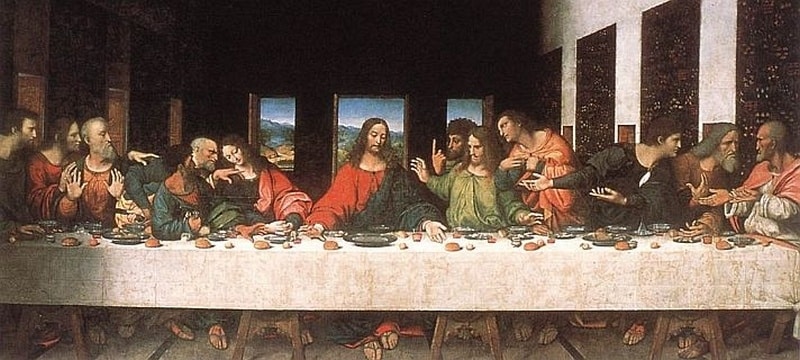
    Leonardo da Vinci’s The Last Supper was painted to show the reaction of each apostle after Jesus said that one of them would betray him. The men in the painting were identified using the notebooks of Leonardo da Vinci, which were found in the 1800’s. From left to right, counting by the head of each man, here are the names of the disciples:

    • Bartholomew
    • James Minor (son of Alpheus)
    • Andrew
    • Judas Iscariot
    • Peter
    • John
    • Jesus is, of course, in the middle
    • Thomas
    • James Major
    • Philip
    • Matthew
    • Thaddeus
    • Simon

    Some have claimed that John isn’t John…that Leonardo actually painted a woman there, and that the woman is Mary Magdalene. This certainly isn’t the case, based on da Vinci’s notes.

  • My Very Own Hamsterdance

    My Very Own Hamsterdance

    I’ve had a Hamsterdance page since the 1990s…and I’m not going to apologize for being hypnotized by it. For the full experience, play the audio clip below.


    Read the compelling story Heaven is for Hamsters

    Read 'Heaven is for Hamsters'
  • Heaven is for Hamsters

    Heaven is for Hamsters

    Heaven is for Hamsters is fairly long, but worth reading. It’s part of an actual conversation between PW and Honus, in which PW is trying to convince Honus to share the Gospel of Jesus with his hamster. Really…I’m not joking. If it seems a bit disjointed, remember that it’s a cut-and-paste conversation that occurred on Deja.com over a period of time…and we’re picking it up in progress.

    Honus is my brother, Jeff. He passed away in 2019. Despite more than one profession of faith during his younger years, he claimed to be an atheist for his entire adult life. He died at home, alone. I don’t know if Jeff reached out to God in his final moments, but I hope that he did. Everything you read on GodWords was first put through “The Jeff Filter.” That is, I never post anything without wondering what my brother would say about it. If he would think it was nonsense, I figured I needed to explain it better. In spite of our differences in faith, Jeff had no trouble seeing that most of what I write is at least coherent. I miss him, and hope to see him again…but not right away.

    PW: But God created every living creature for His Spirit. My little dog listened to Christian radio with me. He would be lying down, obviously listening to it, before I came into the room. I could see the look on his face when they talked about Jesus.

    Honus: A purely Pavlovian response. Anyway, perhaps what’s happening is your dog, a little one and an indoor one at that, has been sitting beneath your dinner table. During the blessing for the meal, he consistently hears certain words, one of them being “Jesus.” Thus, when he hears “Jesus” on the radio, he pays attention because he thinks it’s chow time. Those aren’t God’s church bells ringin’, they’re Pavlov’s dinner bells. I get the same sort of (I assume) blissful expression on my face when I hear my wife talk about “dinner.”

    On a more serious note, isn’t it bad enough that humans have to suffer all manner of terrors because of Adam and Eve, but all of the animals on the earth are in danger of suffering through horrible lives and deaths as well? That doesn’t sound like something coming down from a just god to me. Are you implying that animals have a sense of right and wrong, akin to what Christians charge humans as having? Is that why God didn’t just kill the evil humans with a flood, he killed all of the animals too? Because they have sinful natures? (Don’t tell me your dog never does wrong.) If your dog has some sense of Jesus and who he is, what else is he aware of? Animals must be aware of sin, if they’re suffering because of it. Otherwise, that definitely would not be just. Punishing the innocent never is. And where do you draw the line from the complex creatures like dogs, to the ‘simple’ ones like yeast? What’s the criteria?

    Jeeze…at least my dog theory is falsifiable.

    PW: No, I did not often say grace aloud at dinner. We have rarely done this at mealtime in my immediate family. This would confirm how hypocritical we Christians can be.

    Honus: I’m surprised that the Christians here who do have verbal blessings at mealtimes haven’t spoken up in offense at being called hypocrites. After all, you did just insult a lot of people.

    PW: What I meant was that you might assume that a Christian who does not say his prayers is a hypocrite. That isn’t true, of course, but a lot of Christians and non-Christians might think so. I sometimes pray in my head, before I eat. My family does pray out loud on special occasions. And when visiting one set of grandparents, my grandfather usually said grace.

    Yes, I do believe that animals do have a sense of right and wrong. In the case of individual animals this can be eroded, suppressed, or developed. This means that they’re moral creatures just like we are, although to varying degrees.

    Honus: And that raises any number of philosophical problems. I see images of sheep in confessionals before being sacrificed, to be sure that they’re “without blemish” on the inside as well as out. I think sacrificing an immoral sheep to the Lord would be quite offensive to him.

    PW: Well, don’t expect me to understand the Old Testament Law in light of this.

    Honus: I wouldn’t ask you to make sense of the nonsensical were your faith not as strong as it appears to be. Doesn’t it make much more sense that animals are amoral based solely on the fact that a freckle on a sheep’s ass rendered it unsuitable for a sacrifice to Jehovah, while no mention is made about whether or not the sheep is in accord with the will of God in its heart? And what if the sheep doesn’t want to be sacrificed? If he knows right from wrong, etc. then he must have some degree of free will since you maintain that animals can choose their “path” in some fashion. What if he doesn’t like your god, and doesn’t want to be sacrificed to him? What if the sheep was a Christian, or the pre-Jesus equivalent? Don’t you see anything wrong with sacrificing him? Sounds kind of pre-Columbian Central/South American-ish to me. (Not that human sacrifices weren’t performed elsewhere.)

    PW: God wanted the best from His people. God knew the heart of each animal sacrificed. The human Hebrew owners usually didn’t. Besides, as the New Testament writers said, the sacrifices were only shadows and symbols of what Christ was to do-to take our sins away to Hell Himself. Not that most of the Levites knew that, much less any pagans.

    Honus: What if the sheep was a Christian, or the pre-Jesus equivalent?

    PW: Then he or she will probably trust and obey. God will take him or her up to be with Him.

    Honus: Is that hypothesis testable? Would a Christian animal willingly submit itself to be put to a sacrificial death, or would the animal know somehow that the execution of Jesus did away with the need for animal sacrifice…thus the animal/victim would know that the sacrifice would be pointless?

    Which brings up yet another dilemma…when did you last eat meat? Do you see no problem with eating what you believe to be sentient creatures, who worship the same God that you do?

    PW: I rarely have thought about that. It is one reason for why I will not eat many species.

    Honus: Well, then…you’ve given it some thought. How do you know which ones can be eaten or not? Do you have any rule of thumb, or is it just gut level instinct?

    PW: It is gut level instinct.

    Honus: Hmm. My gut level instinct tells me to fill it with meat at every opportunity that presents itself.

    PW: Actually I do have my reasons. It would not be right to betray the trust of any living creature.

    Honus: I’m not talking about eating the family pet…I’m talking about the flesh wrapped up in plastic at your grocer’s. You’re not on speaking terms with a lot of livestock, are you? Eating a pig that you’ve never met isn’t exactly a betrayal of trust.

    [Picking up in the middle of a thought]

    PW: …and between species of course it varies, generally with intelligence. Less intelligent animals can obey God, too.

    Honus: If they can obey, they can disobey. Does that mean that bad dogs will go to Hell? If they know who Jesus is yet continue to poop indoors and chase cats, will they someday sit before the judgment throne and answer to God for their actions? Is it not in their nature to chase cats? How can they be faulted if it is? Do you consider your dog to be a Christian?

    PW: The issue is not obeying rules but of one’s will; will you obey God, and whose side are you on. God is Who HE IS. He has created within every creature a sense of Who HE IS. He wants to give His Spirit to every living creature.

    Honus: The bacteria rampaging in my throat right now don’t give a damn about Jesus. (Or aren’t they “creatures?”) I don’t think that my hamster does, either. And I know that Mrs. Honus’ cat doesn’t because she’s a cat…she doesn’t give a damn about anybody.

    PW: Your hamster might, if told about Him. Same with your cat. (Although I know what you mean.)

    So that at the Name of Jesus every knee shall bow: of things in heaven, things on Earth, and things under the Earth; and every tongue shall proclaim that Jesus Christ is Lord, to the Glory of God the Father. Philippians 2:10-11.

    Honus: I really don’t think that that applies to animal knees, and animal tongues.

    PW: Well I do.

    Honus: And why does the refrain “Four legs good…two legs ba-aa-aa-d” keep running through my head?

    PW: A dog, like anyone else, will not go to Heaven for being good, but for accepting Jesus Christ, through His death on the Cross, as his or her personal Savior.

    Honus: Animals do not have sinful natures, unless the answer to the age-old question “Who was Cain’s wife?” is “A goat.” in which case maybe you can argue (from a theistic standpoint, with no scientific basis) that all goats have sinful natures passed down to them from Adam. That obviously applies only to goats, and doesn’t cover all of the other “kinds” of creatures that have graced the planet. How can animals require redemption when they’ve never fallen? Come on…you’re screwing with me, aren’t you? If I find out that you’re racking up Loki points (for trolling) at my expense I’m gonna be pissed! Not that that means anything, but…you know. It’s rude.

    PW: God will hold every dog accountable, but He will forgive. He will understand, because He knows how He made each dog.

    Honus: You mean that God gave them that sinful nature that he’s going to send them to hell because of? I don’t see where else they got it, unless Adam’s original sin imparted a sinful nature to all of sentient creation… which would hardly be fair, or just.

    PW: My dog did a lot that I did not approve of, but he obviously believed in and trusted Jesus. Yes, I do consider him to have been a Christian dog. I will see him when Christ returns.

    Honus: Hell is really going to stink…have you ever smelled burning fur? And tossing water on the burning dogs (if there’s any to be tossed) won’t do much good either…wet dogs stink, too. As much as I envied the guy when I was a child, I don’t believe in Dr. Dolittle. (All parrots should be named Polynesia, IMO.) Just how exactly does one proselytize to a rodent? In English? Do I just read Bible verses to him? Do I merely repeat The Sweet Name o’ Jesus over an over, and hope that it sinks in? Do I look for a wistful expression on the hamster’s face to know that he’s been saved? Do you have any idea how much that would weird me out, seeing an expression on his face? I don’t care if it’s a happy one or not. And don’t you have to confess with your tongue that Jesus is Lord upon your conversion? How is Binky going to do that? And to who? I don’t want to hear about it, and I won’t let him attend church services. Come to think of it, neither will they. Isn’t that wrong? What if he truly loves Jesus? Bigotry is just unacceptable, and they ought to let him in. And if animals have souls and can choose right from wrong, and whether or not to accept Jesus and his redemption of their sins, then shouldn’t Christians be out trying spread the gospel to them as well as to humans? Or do humans simply have a greater priority? Why? Because they can give their 10% tithes in cash? Why don’t we see preachers at each slaughter-house ministering to those about to die, as we see them comforting those on Death Row? What’s the difference? Do Christians bless their meals because they might be about to ingest heretical beef? What about the mashed potatoes? Are they not creatures? Where do you draw the line between animal and vegetable? I hear that it gets pretty fuzzy at times, when you get to the smaller scales. And besides…hamsters are originally from Afghanistan. Preaching Christianity to them could very well start a jihad that we really don’t want to get mixed up in, don’t you think?

    [Again, picking up in the middle of another thought]

    PW: As for your bacteria, they do recognize Him for Who HE IS. They would care about Him, one way or the other. In some sense.

    Honus: Without brains? What about living creatures like viruses and phages? They’re little more than macromolecules. Are they plants, or animals? Do they too recognize God in some fashion? How? There’s nothing to them. (At least for the sake of this discussion.) When I drink a beer, does the yeast immediately go to be with the Father? Do angels sing when the soul of a hamster is redeemed? How can you apply that verse in a literal sense and claim that it covers animal life as well as human life, when the vast majority of animal life has neither tongue nor knees? How can animals require redemption when they’ve never fallen?

    PW: Animals did not need to fall by Adams means, much less through his and Eve’s sins. But they fell through the same basic motives. They each want to serve themselves.

    Honus: Can I assume that you can give me some biblical references to support this? I can see someone asserting the position that Adam’s fall corrupted everything on the planet, not that I like the idea…but I don’t see any support for the idea that animals are in need of redemption because of their own actions.

    PW: Each one of them is conceived and born or hatched into a universe captured by Satan. That is why each one of them needs redemption by Jesus.

    Honus: I’m sorry, but that makes no sense. Just because tyrant “A” occupies or controls a particular region really has nothing to do with the people living within said region. The place of your birth can hardly make you guilty of something, the Crusades not withstanding.

    Can I assume that you can give me some biblical references to support this? I can see someone asserting the position that Adam’s fall corrupted everything on the planet, not that I like the idea…but I don’t see any support for the idea that animals are in need of redemption because of their own actions.

    PW: The Bible does not contradict it, and it makes sense to me.

    Honus: And you’re comfortable basing an entire aspect of personal doctrine on this? Because it feels good, and the Bible doesn’t specifically rule it out? There’s no limit to what one can choose to believe, if that’s the criteria.

    PW: Satan has gotten control over the wills of every living creature. The “free will” of a creature not saved through the power of the Holy Spirit through Christ is in Demonic spirits. Yet the Holy Spirit moves through the wills of unsaved creatures too and, no, I do not have it all worked out.

    Honus: Well…if you’re making it up as you go along, it shouldn’t be -too- hard.

    If he got control over animals, and they have the same morality as you and I with a need for redemption, etc., then he got that control directly from the hand of God. They didn’t do anything to deserve that fate. They’re without original sin.

    Coincidentally, my four year old daughter was butted in the head by a big goat the other day as he was trying to push aside the smaller goats to get to the handfuls of food that she was offering them. Did the goat know that he was doing wrong, or was he just a dumb animal who didn’t know any better? Think carefully….a goats life hangs in the balance. (I know where that bastard lives.) Or does “Vengeance is mine,” saith the Lord” apply here?

    PW: I don’t know. Was he your goat?

    Honus: No, but that’s utterly beside the point. I don’t care whose goat he was. If I really believed that the goat was an intelligent, thinking, free moral agent capable of knowing right from wrong as you’ve indicated, and that he deliberately hurt my child like he did, I’d have likely killed him on the spot. Ultimately, what I’m getting at is do you advocate trials for animals that do wrong? It’s been done many, many times before. If they’re free moral agents as you believe, why don’t we try them? Weren’t bulls that gored men in Biblical times killed? If you were King, or if Jesus reigned, could I file assault charges?


    PW: No, I do not advocate trials for animals. I do believe that dogs, for example, can be taught that certain behavior is wrong.

    Honus: WHOA! What do you mean, “taught?” I agree that they can be taught not to do certain things, but not because I’m in some sort of struggle to over-ride their sinful natures.

    PW: I assume that you have already worked things out with the goats owner.

    Honus: Yeah…I gave him more money, and he gave us more food for the goats. (It was a petting farm.) It’s not worth suing over, simply because sometimes poop happens. And if the goat was just being a goat, as I believe it was, it’s not worth killing him over it. He’s just a dumb animal that doesn’t know better. You seem to have missed my point. Does the goat need to be “taught” that head-butting beautiful little girls is wrong? Does he instinctively know without being taught? Or is he just a goat?

  • Does Sin Separate Us From God?

    Does Sin Separate Us From God?

    Yes, it’s true: the sins of the entire world are missing…at least as far as God is concerned, anyway. Many people think that God keeps close track of everyone’s sins (the better to condemn you with, my dear) but nothing could be further from the truth. The fact of the matter is that SIN has been a dead issue for a long, long time! How can we be sure, you ask? Simple. The Bible explains it quite clearly:

    God was in Christ reconciling the world to Himself, not counting their trespasses against them.

    2 Corinthians 5:19

    Most Christians are unfamiliar with this passage of Scripture. To be fair, they’re unfamiliar with most passages of Scripture…but that’s a topic for another day. The point is that when Jesus died, He took away all of the sins of the world. That includes all of yours and all of mine. Every sin, for every person, for all time. He didn’t just deal with the sin of those who believed in Him, either…He died for everyone. He ‘became sin’ so that we would have the opportunity to ‘become the righteousness of God’. Notice: every sin you’ve ever committed happened AFTER Jesus died, right? That means that they’ve all been taken care of. Jesus isn’t going back onto the cross — His work is done! God reconciled the world to Himself through Christ, and doesn’t count our sins against us. That’s good news!

    However, some will undoubtedly ask: “Since all sins for all time have been forgiven, will everyone go to heaven?” Certainly not. If sin were the problem, sure…but it isn’t sin that keeps us from God…it’s our unwillingness to submit to His authority! When we submit to God, He sends the Holy Spirit to dwell in us and immediately give us eternal life. It isn’t GOD that avoids the unsaved — it’s the other way around! The barrier of sin came down a long time ago, and the only barrier left between Man and God is PRIDE. If you’re not a Christian, I’ve got good news: God isn’t mad at you…in fact, God’s crazy about you!

    Okay, so sin is a dead issue…are we free to disobey? Of course not! Is repentance from sin unnecessary? Certainly not! Repentance is turning away (literally “changing your mind”) from the sins that you commit. The fact that Jesus took the punishment for our sins doesn’t mean that we can do whatever we want. Why would we slap God in the face after He gives us eternal life? Turning from sin is an important part of Christ-likeness and maturity. Jesus said that He came to give us abundant life, and it’s unlikely that such a life is possible when you’re insulting God by continuing to sin.

    Religious people are often quick to point out the sins and weaknesses of others…a fact not missed by Jesus Himself. It’s interesting to note that He condemned the self-righteous religious elite of His day but didn’t condemn the woman caught in adultery! While the Pharisees prided themselves on following the letter of the Law, the adulterous woman didn’t seem to care about what God expected from her. One might expect Jesus to praise the Pharisees for their hard work, and to chastise the woman for neglecting her spiritual duties…but the Pharisees caught the brunt of Jesus’ harshest words, and Jesus was kind and gentle toward the sinful woman. He did tell her to go and sin no more, but didn’t He condemn her like the others did. That’s two things we should all remember…first: that Jesus isn’t our accuser, and second: that God doesn’t think too highly of self-righteous condemnation.

    So, let’s put the puzzle pieces together, shall we? Only those who submit to God and accept the salvation that He offers will receive eternal life. Those who do submit receive eternal life, and the abundant earthly life Jesus talked about can be theirs as well. What do those who don’t submit get? Hell…the Bible is clear in that regard. No eternal life…only eternal separation from God. That’s bad news! The passage above hints about how serious this is…Paul instructs Christians to appeal to (and even beg) our neighbors to be reconciled to God. That is our ministry. NOT to point out their sins and condemn them, but to act as ambassadors for God, speaking for Him. The Holy Spirit convicts of sin (John 16:8)…it’s our job to share the Gospel. The Gospel or “good news” is that Jesus gave us access to eternal life by dying the death that we deserve.

    What separates us from God? Simply that we choose to ignore Him…to drown out His ‘still, small voice’. There are lots of voices shouting at us, trying to get our attention. The loudest isn’t always the best! Please: be reconciled to God…otherwise, the death that Jesus died for YOU will have been in vain.

  • Scientology FactSheet

    Scientology FactSheet

    Founder:
    Lafayette Ronald Hubbard
    Born March 13, 1911 in Tilden, Nebraska
    Founded:
    1954 in Washington, D.C.
    Founding Occasion:
    The release of Hubbard’s book Dianetics: A Modern Science of Mental Health
    Headquarters:
    Los Angeles, California
    Membership:
    Approximately 8,000,000
    Current Leadership:
    Heber Jentzsch
    Parent Religion:
    New Thought (Christianity)
    Sacred Texts:
    Dianetics: A Modern Science of Mental Health
    Foundational Principle:
    Humans are actually invisible space creatures called Thetans. We don’t realize our true nature because of traumatic experiences. If we could overcome these traumas, we would realize who and what we are.
    Official Website:
    www.scientology.org
  • Rastafarianism FactSheet

    Rastafarianism FactSheet

    Founder:
    Born Ras Tafari, Ethopian emperor Haile Selassie is considered by Rastafarians to have been the Lion of Judah, and a manifestation of God. Selassie claimed direct descendence from King David, the 225th ruler in an unbroken line of Ethiopian Kings from the time of Solomon and Sheba. Rasta is rooted in the teachings of Marcus Garvey, who in the 1930s preached black self-empowerment and initiated the “Back to Africa” movement.
    Founded:
    Approximately 1930
    Founding Occasion:
    The crowning of Emperor Haile Selassie 1 of Ethiopia and his proclamation as “King of Kings, Lord of Lords, and the conquering lion of the Tribe of Judah”.
    Headquarters:
    Many Rastas consider Africa to be heaven on earth.
    Membership:
    700,000
    Current Leadership:
    None…Rastafarianism is basically a loose-knit group of like-minded believers.
    Sacred Texts:
    The Holy Piby
    The Bible, to some extent
    Official Website:
    www.rastafari.org
  • Unification FactSheet

    Unification FactSheet

    Also known as “Moonies”
    Also known as “The Holy Spirit Association for the Unification of World Christianity”

    Founder:
    Yong Myung Moon (Sun Myung Moon)
    Born January 6, 1902 in North Korea
    Founded:
    May 1, 1954
    Founding Occasion:
    Moon’s vision of Jesus Christ at age sixteen
    Headquarters:
    Seoul, Korea
    Membership:
    Approximately 3,000,000
    Sacred Texts:
    Divine Principle
    The writings and sayings of Reverend Moon
    Foundational Principle:
    Sun Myung Moon is the manifestation of God on earth.
    Official Website:
    www.unification.org
    www.unification.net
  • Mormonism FactSheet

    Mormonism FactSheet

    Also known as “The Church of Jesus Christ of Latter-Day Saints”

    Founder:
    Joseph Smith, Jr.
    Born 1805 in Sharon, VT
    Founded:
    April 6, 1830
    Founding Occasion:
    A visitation by God and Jesus in which he was chosen to restore lost Christianity
    Headquarters:
    Salt Lake City, UT
    Membership:
    Approximately 11,000,000
    Current Leadership:
    President Gordon B. Hinckley
    Parent Religion:
    Christianity


    Sacred Texts:
    The Bible (The King James Version is officially preferred)
    The Book of Mormon
    The Pearl of Great Price
    Doctrine and Covenants
    Foundational Principle:
    As man is, God once was. As God is, man may someday become.
    Official Website:
    www.lds.org
    www.mormon.org
    farms.byu.edu
  • Jehovah’s Witnesses FactSheet

    Jehovah’s Witnesses FactSheet

    Founder:
    Charles Taze Russell
    Born 1852 in Pittsburgh, PA
    Founded:
    Approximately 1876
    Also known as:
    Originally “International Bible Students Association”
    Renamed “Zion’s Watch Tower Tract Society” in 1884
    Renamed “Watch Tower Bible and Tract Society” in 1896
    Renamed “People’s Pulpit Association” in 1909
    Renamed “Watch Tower Bible and Tract Society” in 1909
    Renamed “International Bible Students Association” in 1914
    Renamed “Jehovah’s Witnesses” in 1931
    Note: The name “Jehovah’s Witnesses” was taken to avoid confusion between the Watchtower organization and others who claimed to be the true followers of Russell, calling themselves the Laymen’s Home Missionary Movement and the The Dawn Bible Students.
    Founding Occasion:
    Russell began a Bible study in 1870 and was later voted “Pastor” by his students
    Headquarters:
    Brooklyn, New York
    Membership:
    5,912,492 in 1999
    Current Leadership:
    Milton G. Henschel
    Parent Religion:
    Christianity
    Sacred Texts:
    The Bible (New World Translation)
    Official Website:
    www.watchtower.org